

Grunt-Free Godliness
Why the Fruit of the Spirit Isn’t a To-Do List

![[HERO] Grunt-Free Godliness: Why the Fruit of the Spirit Isn’t a To-Do List](https://substackcdn.com/image/fetch/$s_!859r!,f_auto,q_auto:good,fl_progressive:steep/https%3A%2F%2Fsubstack-post-media.s3.amazonaws.com%2Fpublic%2Fimages%2Fd754d2f3-aa9d-4f93-b4aa-636cad5c60ba_1024x1024.webp "[HERO] Grunt-Free Godliness: Why the Fruit of the Spirit Isn’t a To-Do List")
It seems like a lot of us are tired. We are exhausted from trying to be “good Christians.” After fifty years in ministry, surviving Stage 4 kidney cancer, and coming through a brutal bout with COVID, the Lord has been teaching me something fundamental. I’ve realized that much of my life was spent “grunting.”
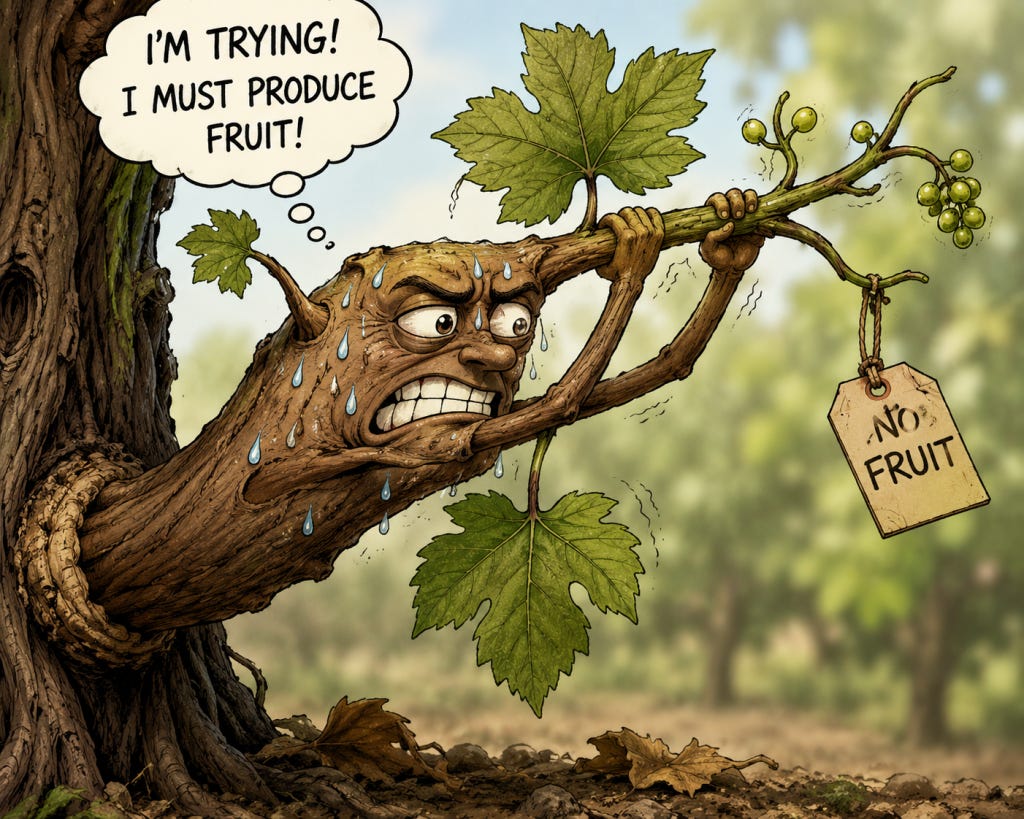
When I say grunting, I’m talking about that human grit. It’s that teeth-clenching, vein-popping effort we put into trying to manufacture spiritual results. We treat the Christian life like a gym workout where the goal is to lift enough “righteousness” until we finally look like Jesus. But here is the secret I’ve found in the quiet of a hospital room and the stillness of recovery: godliness is grunt-free. If you are sweating and straining to produce the Fruit of the Spirit, you’ve likely mistaken a gift for a to-do list.
The Singular Nature of the Fruit
Most people look at the famous passage in Galatians and see a shopping list. We think, “Okay, today I need to work on my patience. Tomorrow, I’ll try to be more joyful.” We treat these qualities like individual modules we have to master through sheer willpower. However, if we look closely at the language, we see something very different.
Galatians 5:22-23 “But the fruit of the Spirit is love, joy, peace, longsuffering, gentleness, goodness, faith, Meekness, temperance: against such there is no law.”
Notice that the word “fruit” is singular. It isn’t “the fruits of the Spirit.” You don’t get to pick and choose which ones you want to grow. When the Holy Spirit is allowed to move in a person’s life, He produces a singular harvest. Consequently, these aren’t nine separate tasks for you to accomplish; they are the nine-fold description of the life of Jesus manifest in you.
Specifically, we must understand that this fruit is a byproduct of presence, not performance. You cannot manufacture joy any more than a branch can manufacture a grape. Therefore, if the fruit isn’t showing up, the answer isn’t to grunt louder or try harder. The answer is to check your connection to the source.

Grit vs. Grace: The Great Divide
For years, I operated on grit. I thought that if I just prayed longer, preached harder, and pushed myself further, I would eventually arrive at a place of perfect godliness. This is the performance trap. We believe that our effort is the engine of our sanctification. Meanwhile, the New Covenant tells us that grace is the engine.
Grit is human effort. It is the attempt to use the flesh to please the Spirit. For example, have you ever tried to “force” yourself to be long-suffering? You sit there, face turning red, telling yourself, “I will not be angry, I will not be angry.” That is grunting. It is a temporary behavioral modification that eventually fails because the heart hasn’t changed.
On the other hand, grace is the supernatural result of the Spirit. When you realize that you are already loved, accepted, and held by God, something shifts. You stop auditioning for His favor. As I discussed in The Big Leap of Faith, believing God loves you exactly as you are is the starting point for all real change. When you rest in that love, the “grunting” stops and the “abiding” begins.
Abiding in the Vine
If we want to understand how fruit actually grows, we have to look at the words of Jesus. He didn’t give us a manual on how to “do” better; He gave us a metaphor for how to “be” with Him.
John 15:4-5 “Abide in me, and I in you. As the branch cannot bear fruit of itself, except it abide in the vine; no more can ye, except ye abide in me. I am the vine, ye are the branches: He that abideth in me, and I in him, the same bringeth forth much fruit: for without me ye can do nothing.”
Think about a branch on a vine. Does it look stressed? Does it look like it’s worried about its “patience quota” for the month? Of course not. The branch’s only job is to stay connected to the vine. If the connection is healthy, the sap flows. If the sap flows, the fruit happens. It is organic, natural, and, yes: grunt-free.
“Abiding” is just a religious word for “resting.” It means settling into the reality of who you are in Christ. When I was dealing with those tumors and the uncertainty of my health, I couldn’t “do” much of anything. I couldn’t run ministry programs or travel the world. I just had to abide. I found that in that place of weakness, the fruit of peace and joy was more prevalent than when I was at the height of my “performance.”
The Soil of Rest
Growth doesn’t happen in the noise of striving; it happens in the soil of rest. This is a hard concept for us because we live in a culture that rewards the hustle. We think that if we aren’t busy “doing” for God, then we aren’t “growing” for God. However, the Bible teaches us that the Christian life was never meant to be powered by fear, pressure, or performance. It was meant to be lived from a place of being loved first.
When you stop trying to fix yourself and start letting Him hold you, you provide the environment for the Spirit to work. Rest doesn’t come after you fix yourself. Rest comes first.
Matthew 11:28 “Come unto me, all ye that labour and are heavy laden, and I will give you rest.”
If your spiritual life feels like a heavy burden, you are likely carrying something Jesus never asked you to carry. He doesn’t want your “grunts.” He wants your surrender. He wants you to realize that the work was finished on the cross. Your job is not to finish what He started; your job is to live in the light of what He has already done.
Long-suffering is a Supernatural Result
Let’s take one specific part of the fruit: long-suffering. In our natural “grit” mode, we think long-suffering is just having a high pain tolerance or a long fuse. But biblical longsuffering is something far deeper. It is the ability to remain constant and joyful under pressure, knowing that the Father has the situation in His hands.
You can’t manufacture that kind of peace when life goes sideways. I remember sitting with Betty: we’ve been married since 1973, and she’s seen me at my best and worst, and realizing that the only way to get through the “cancellation” and the health trials was to stop trying to defend myself and stop trying to “power through.” I had to let the Spirit produce the long-suffering.
When you are rooted in grace, you don’t have to protect your reputation or your comfort. You are already secure in Him. This security allows you to be gentle when people are harsh and faithful when things are uncertain. It isn’t your strength; it’s His life flowing through you.
Moving from Performance to Presence
So, how do we practically stop the grunting? It starts with a shift in focus. Instead of waking up and asking, “How can I be more patient today?” ask, “How can I enjoy God’s presence today?”
When you prioritize your relationship with the Father, the behavior takes care of itself. Loved people naturally become loving people. If you find yourself struggling with a lack of kindness or self-control, don’t run to a self-help book. Run to the Father. Remind yourself of your identity. You are a beloved child, not a hired servant trying to earn a paycheck.
I spent years in the “performance trap,” and I can tell you from experience, it is a dry and weary land. You can read more about my journey through that in Fruit of My Failure. The freedom found on the other side of “grunting” is worth every bit of the struggle it takes to let go of our pride.
The Assurance of His Grace
As you move forward, I want you to remember this: God is not disappointed in you. He is not measuring your worth by your consistency. He sees you through the lens of His Son, and in Him, you are already “enough.”
Your growth is His responsibility. Your job is to stay close. Stop the grunting, stop the straining, and just breathe in the grace that is already yours. The fruit will come. It might not come as fast as you want, but it will be real, lasting, and beautiful.
You can rest now. Christ is enough, the work is done, and His mercy is following you every single step of the way.

Frequently Asked Questions
Why do I feel like I have to work so hard to be a good Christian?
This feeling usually stems from a performance-based mindset that believes God’s love is conditional on our behavior. When we shift our focus to the “finished work” of Christ, we realize that we are already accepted, which allows us to grow out of love rather than fear.
Is there any effort required in the Christian life?
The “effort” in the Christian life is the effort to remain in a state of surrender and abiding. It is the daily choice to believe God’s Word over our feelings and to stay connected to the Vine through prayer and focus on His grace.
How can I tell the difference between “grit” and “grace” in my life?
Grit usually leaves you feeling exhausted, frustrated, and self-righteous when you succeed. Grace leaves you feeling peaceful, humble, and full of gratitude, regardless of the immediate outcome.
Are you ready to stop the striving and start resting?
Listen to the Podcast: Join me on Followed by Mercy as we dive deeper into living a life of grace.
Watch on YouTube: Subscribe to @waustingardner for weekly encouragement and teaching.
Deepen Your Faith: Read more about finding your identity in Christ at Alignment Ministries.
#Grace #FaithBasedDevelopment #AustinGardner #FruitOfTheSpirit #FollowedByMercy